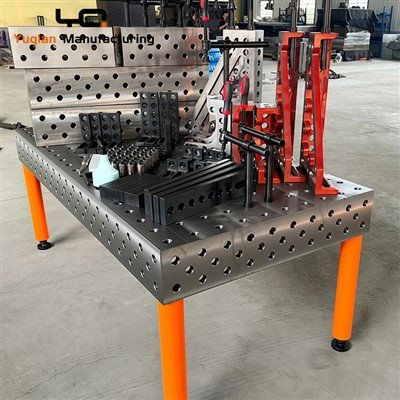
This worktable consists of a base, column, clamping beam, moving structure, gantry base, linear guide rails and slider structure, electric motor and reducer assembly, coupling, gear and rack assembly, electric cylinder, gantry work platform, gantry support wings, clamping shaft, clamping shaft pivot, clamping block, air bladder, manual reversing valve, and base plate. Its advantages include synchronized lifting and moving, high precision, smooth electric movement, stable clamping, improved welding quality, reduced preparation time, and increased worktable efficiency.
High-Power Welding Worktable: Used for welding and desoldering through-hole and surface mount components. This welding worktable uses a high-power, long-life ceramic heater and features closed-loop feedback temperature control, thus achieving efficient and precise welding.
Flexible Three-Dimensional Combined Welding Fixture
A multi-angle rotating welding worktable comprises a table body, a base, a hydraulic cylinder, a cylinder seat, a worm gear, a worm wheel, and a worktable. The table body is conical with a 90-degree taper at the lower end, which is connected to the base via a shaft. One end of the hydraulic cylinder is connected to the cylinder seat via a shaft, and the other end is connected to the lower end of the table body via a shaft. A worm gear is fixed inside the table body and connected to the worktable. An operating handle is connected to the worm wheel. This invention allows the workpiece to be fixed at any position within a 90-degree range in the vertical direction and a 360-degree range in the horizontal direction, facilitating operation and ensuring welding quality.
The three-dimensional combined welding worktable surface uses a perforated grid plate with two hole diameters: D28 and D16. On the high-precision table surface, D28 holes are evenly distributed every 100mm or D16 holes are evenly distributed every 50mm. These holes can be used to assemble various functional positioning modules and fixtures. In addition to the tabletop, the various functional modules include positioning blocks, right-angle blocks, columns, arbitrary angle adjustments, V-blocks, pins, various quick-clamping devices, gap adjustment plates, and various auxiliary modules. The modules are ingeniously designed, allowing for various combinations and repeated applications. The pins used for fastening the modules together employ three concentric steel balls internally. When the pin is loosened, the steel balls retract into the pin, allowing the pin to be easily inserted into the module's hole. When gradually tightened by hand, the three steel balls gradually pop out, automatically centering and clamping the module. When tightened with a wrench, the clamping force on the module can reach 5 tons, and the shearing force can reach 25 tons.

The outstanding advantages of this combination fixture are:
1) Modularity: All components are categorized, standardized, and serialized, ensuring mutual compatibility. Using a minimal number of modules, various quick positioning and clamping functions can be achieved.
2) Flexibility: Diverse assembly methods allow users to fully utilize their imagination to achieve almost the same positioning and clamping functions as any specialized fixture. Quick assembly and easy disassembly; the worktable can be assembled and combined according to the shape and size of the workpiece. The design of the scales and module dimensions on the worktable allows operators to quickly assemble the required tooling based on the workpiece dimensions without measuring tools.
3) High precision: The worktable and various functional modules have matching D16 or D28 round holes spaced every 50 or 100 mm. The dimensional tolerance of any hole spacing is less than 0.02 mm. This precision will be reflected in the products processed by the user. Therefore, some users also use this worktable as a reference platform for inspection fixtures.
4) Patented design: Many functional modules are patented products, such as the pins used for connecting modules and the specially designed compensated elastic clamps to prevent workpiece displacement during clamping.
5) Three-dimensional design: The columns and right-angle blocks in the modules can be used to assemble into three-dimensional space, facilitating the production of various three-dimensional components.
With this modular welding worktable, users who repeatedly design tooling can greatly save the time and money spent on the design and manufacturing of tooling. Users can quickly assemble tooling to meet different requirements, much like children playing with building blocks. This three-dimensional flexible tooling can be used in the automotive manufacturing industry, construction machinery industry, steel structure production industry, sheet metal processing industry, bicycle (motorcycle) manufacturing industry, and can be used in conjunction with welding robots or specialized welding machines, etc.