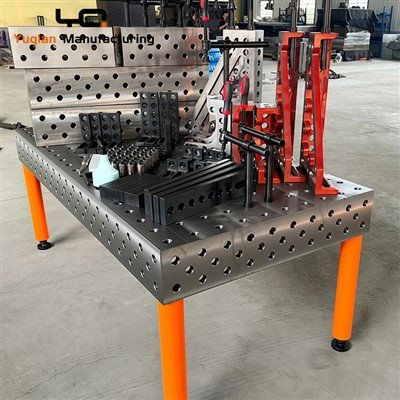
Choosing a steel welding table starts with more than the outside dimensions of the component. Clamps occupy space, the welding torch needs an approach to the joint, and the finished assembly needs a route off the platform.
Take a 1200 × 1200 mm platform. A frame close to that size may sit on the surface while leaving little room for tooling around its edges. A simple layout showing the part and clamp positions makes the discussion more useful than a length and width alone.
Side faces offer further mounting positions on a three dimensional platform. For uprights, consider the height of the locating elements and the order in which the joints will be welded. Inspection tools also need access after the clamps are fitted.
Before ordering a steel welding table, identify the first components to be made and any accessories that will be retained from existing equipment. Include likely changes in part size, even if those parts will enter production later.
We find a drawing with those practical details easier to work from. It gives the platform outline and hole system a clear purpose and leaves time to revise the fixture arrangement before manufacturing starts. Keeping that drawing with the tooling records also gives the workshop a reference when a familiar assembly returns after another job. It also supports later discussions.