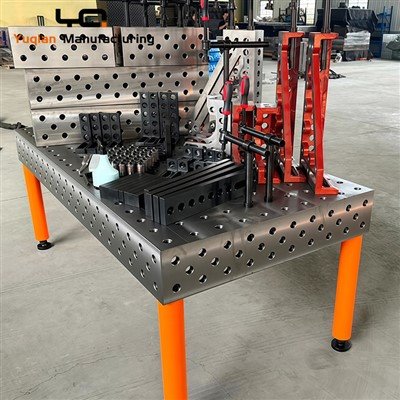
Choosing a modular fixturing table starts with the workpiece, not the accessory count. First define typical part dimensions, welding positions, expected loads, and how often the layout will change. These points determine the table size and the accessories that are genuinely useful. When comparing welding fixture table kits, check the hole system before anything else. D16 and D28 configurations use different compatible parts, so clamps, locking pins, stops, squares, and support blocks must match the selected table. Effective welding fixture table kits should also let operators recreate reference points without complicated tools. Next, review the table material and support arrangement. Cast iron and Q355 or S355MC steel can be used for modular welding platforms, while fixed, adjustable, mobile, telescopic, or lifting legs suit different workshop layouts. Surface treatment also matters where spatter, repeated clamping, moisture, and daily cleaning are common. Size flexibility becomes important when work varies. Standard rectangular tables cover many applications, but round, irregular, or oversized formats may suit special assemblies. Customized welding fixture table kits can be planned around those parts when overall dimensions and fixture locations are confirmed in advance. Before ordering, prepare a concise list of common workpieces, datum directions, and required clamping points. That list defines a practical starting set. The goal of welding fixture table kits is a reusable system that fits current work and can expand as production requirements change.
 English
- English
- Français
- Deutsch
- 日本語
- Italiano
- Español
- Português
- русский
- Norsk
- Lietuvių
- România limbi
- Srbija jezik (latinica)
- Български
- اردو
- عربي
- українська
- Bai Miaowen
- Català
- Türkçe
- Kreyòl Ayisyen
- íslenska
- Svenska
- Indonesia
- Malti
- Việt Nam
- O'zbek
- slovenščina
- Cymraeg
- dansk
- Nederlands
- Gaeilgenah Éireann
- Čeština
- فارسی
- বাংলা
- עברית
- Latviešu
- 한국어
- Polski
- slovenčina
- Ελληνικά
- Melayu
- Eesti
- suomi
- magyar
- हिंदी
- bosanski
- hrvatski
- ไทย