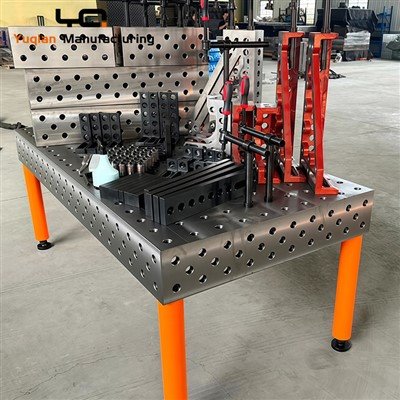
Repeated assemblies become easier to manage when locating points and clamping positions can be recreated without building a new jig for every batch. A modular table provides a fixed reference surface, while accessories can move to match changes in part size or geometry. Well-selected welding fixture table kits combine the table with locking pins, clamps, stops, squares, and support elements. The first step is to confirm the hole system, such as D16 or D28, because every accessory must be compatible with the selected table. The second step is to map the workpiece datum points and clamping directions. This reveals where stops, supports, and clamps are actually needed. Table size is equally important. A surface that is too small restricts fixture placement, while an oversized table may consume unnecessary workshop space. When choosing welding fixture table kits, consider the largest workpiece, normal batch size, operator access, and whether fixed, adjustable, mobile, telescopic, or lifting supports are required. Accessory quantity should follow real jobs rather than a generic list. Frames may need more angle elements and stops, while flat panels may need additional clamps. Expandable welding fixture table kits are useful because compatible components can be added as new work appears. Finally, keep the surface clean and inspect pins and clamps for wear. With recorded datum positions and a consistent setup routine, welding fixture table kits support repeatable positioning while reducing time spent rebuilding fixtures.
 English
- English
- Français
- Deutsch
- 日本語
- Italiano
- Español
- Português
- русский
- Norsk
- Lietuvių
- România limbi
- Srbija jezik (latinica)
- Български
- اردو
- عربي
- українська
- Bai Miaowen
- Català
- Türkçe
- Kreyòl Ayisyen
- íslenska
- Svenska
- Indonesia
- Malti
- Việt Nam
- O'zbek
- slovenščina
- Cymraeg
- dansk
- Nederlands
- Gaeilgenah Éireann
- Čeština
- فارسی
- বাংলা
- עברית
- Latviešu
- 한국어
- Polski
- slovenčina
- Ελληνικά
- Melayu
- Eesti
- suomi
- magyar
- हिंदी
- bosanski
- hrvatski
- ไทย